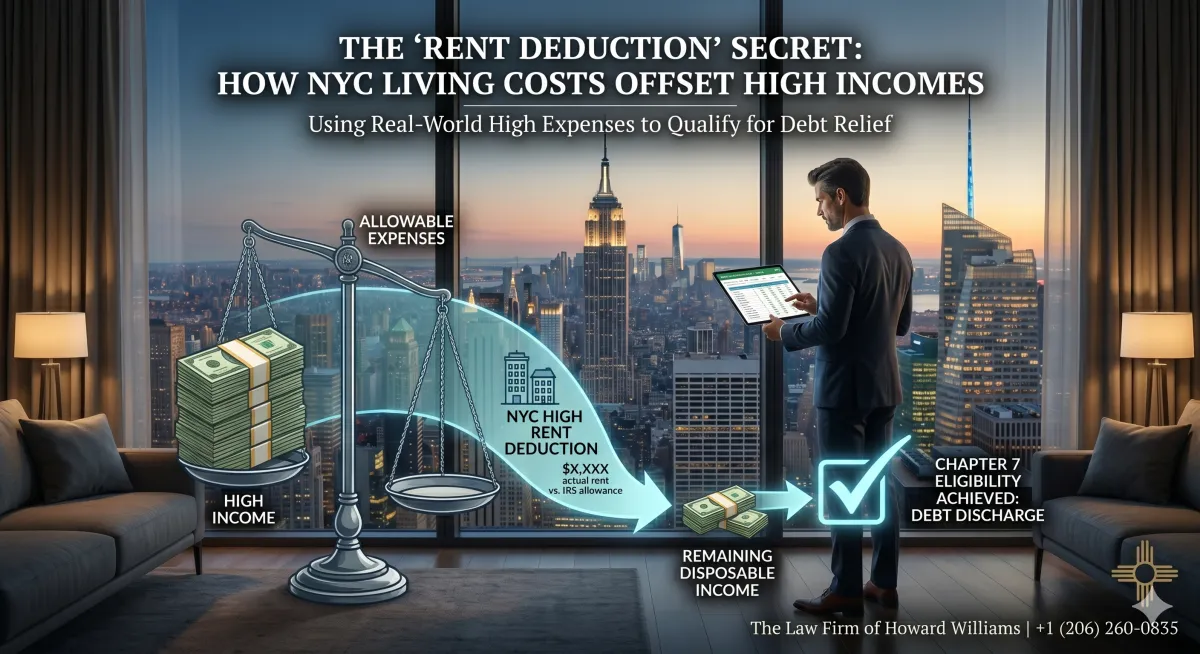
The “Rent Deduction” Secret: How NYC Living Costs Offset High Incomes
If you live in New York City, you already know the reality: a high salary doesn’t always translate into financial breathing room. What many don’t realize is that bankruptcy law actually accounts for this, particularly when it comes to rent.
There’s no official “rent deduction” written into the Bankruptcy Code. But in practice, New York’s high housing costs can significantly reduce your disposable income under the means test, sometimes enough to qualify for Chapter 7 even at a higher income level.
Here’s how it works.
The Misconception: High Income Equals Disqualification
It’s easy to assume that earning a strong salary in NYC automatically disqualifies you from Chapter 7. That assumption overlooks one critical variable: cost of living.
The bankruptcy system isn’t just measuring what you earn, it’s evaluating what you actually have left after necessary expenses.
And in New York, rent is often the largest, and most influential, expense in that equation.
The Means Test: Where Rent Becomes Strategic
The means test determines eligibility for Chapter 7 by analyzing:
Your average income over the past six months
Standardized and actual allowable expenses
Your remaining disposable income
Housing costs fall under allowable expenses, and in high-cost regions like NYC, those allowances are adjusted to reflect local realities.
That’s where the so-called “rent deduction” comes into play.
How NYC Rent Impacts Your Qualification
In practical terms, your monthly rent can:
Reduce your calculated disposable income
Offset a higher gross salary
Bring you within Chapter 7 eligibility thresholds
For example, someone earning $105,000 annually with $3,800 in monthly rent may show significantly less disposable income than someone earning less in a lower-cost region.
The system recognizes that difference.
IRS Standards vs. Real Rent: What You Need to Know
Housing deductions in bankruptcy are guided by IRS Local Standards, which set baseline allowances for rent and utilities.
However, in some cases:
You may justify higher actual housing costs
Courts may allow flexibility depending on circumstances
Strategic documentation becomes critical
This is not a one-size-fits-all calculation. Proper structuring of your expense profile can directly impact your eligibility outcome.
Why This Matters for Chapter 7 Filers
If your disposable income falls below a certain threshold after accounting for rent and other expenses, you may qualify for Chapter 7, which allows for:
Discharge of unsecured debts
Faster resolution compared to repayment plans
Immediate financial relief
For NYC residents, rent isn’t just a burden, it can be a key factor in unlocking relief.
Common Pitfalls to Avoid
Underreporting expenses: Failing to fully account for legitimate costs can hurt your case
Assuming ineligibility: Many high earners never explore Chapter 7 due to misconceptions
Filing without strategy: Timing and documentation matter more than most realize
Final Takeaway
The “rent deduction” isn’t a loophole, it’s a reflection of how bankruptcy law adjusts for economic reality. In a city like New York, where housing costs dominate budgets, that adjustment can make all the difference.
If high rent is eating into your income and debt is piling up, your situation may be more favorable than it appears on paper.
Call The Law Firm of Howard Williams now at +1 (206) 260-0835.
