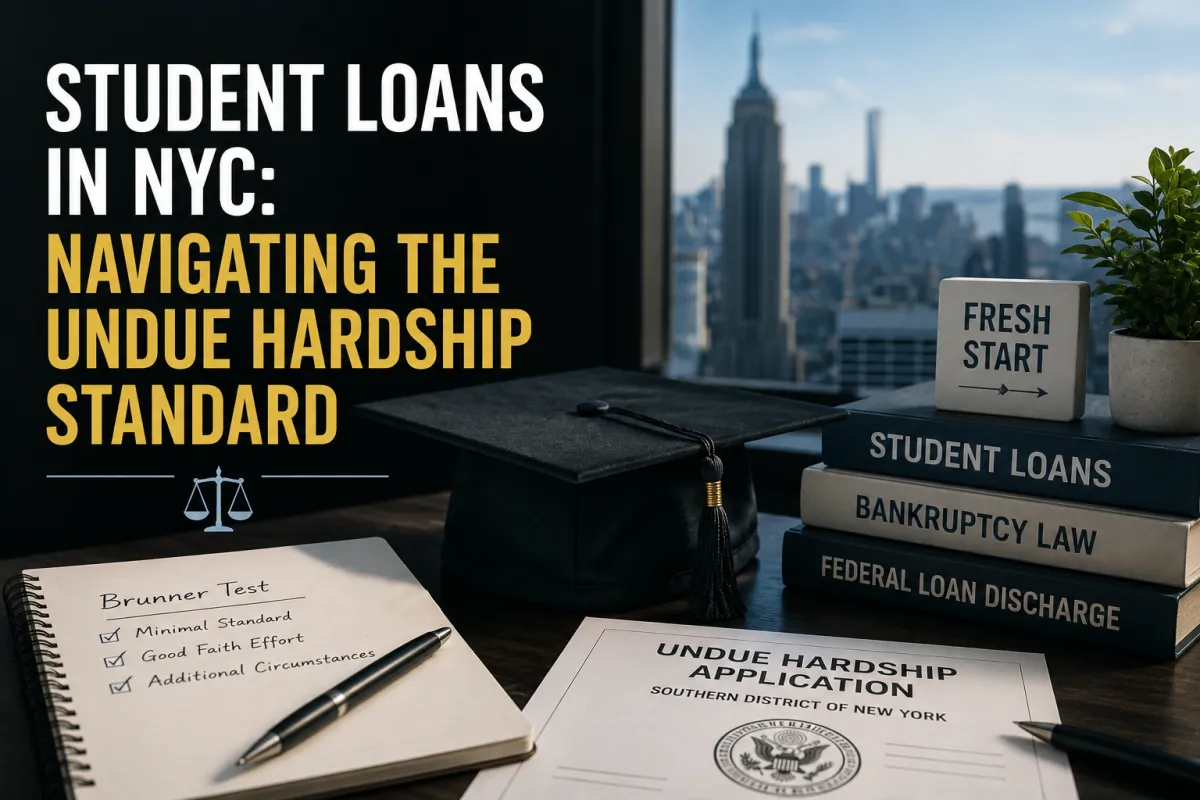
Student Loans in NYC: Navigating the Undue Hardship Standard
Student loans in NYC can sometimes be discharged in bankruptcy, but the borrower must prove “undue hardship.”
That phrase sounds simple. In practice, it requires evidence. New York bankruptcy courts use a legal standard called the Brunner test. Borrowers must show more than stress, high balances, or frustration with loan servicers. They must show repayment would prevent a minimal standard of living, that the hardship is likely to continue, and that they acted in good faith.
Key Takeaways
• Student loans are not automatically erased in Chapter 7 or Chapter 13.
• New York courts use the Brunner test for undue hardship.
• Federal student loan discharge may require an adversary proceeding and attestation.
What Does Undue Hardship Mean for Student Loans in NYC?
Undue hardship means repayment would create more than normal financial difficulty.
Most debts can be discharged in bankruptcy more easily than student loans. Student loans receive special treatment under 11 U.S.C. § 523(a)(8), which excepts certain educational debts from discharge unless repayment would impose an undue hardship on the debtor and the debtor’s dependents (11 U.S.C. § 523(a)(8) – U.S. Code).
The borrower must usually ask the bankruptcy court for a separate ruling.
That separate case is called an adversary proceeding. The Department of Justice explains that student loan dischargeability is reviewed through a formal adversary proceeding in the bankruptcy court (DOJ / U.S. Trustee Program – Student Loan Bankruptcy Guidance).
In NYC, your bankruptcy court depends on where you live. Manhattan and the Bronx generally fall under the Southern District of New York. Brooklyn, Queens, and Staten Island generally fall under the Eastern District of New York (Southern District of New York Bankruptcy Court; Eastern District of New York Bankruptcy Court).
Both districts sit within the Second Circuit.
That matters because the Second Circuit created the Brunner test. This test controls how New York courts evaluate undue hardship. DOJ guidance identifies Brunner v. New York State Higher Education Services Corp. as the source of the most common three-part framework for assessing undue hardship (DOJ / U.S. Trustee Program – Student Loan Bankruptcy Guidance).
The test asks whether the borrower:
• Cannot maintain a minimal standard of living if forced to repay
• Faces circumstances likely to continue for a significant repayment period
• Made good faith efforts to repay the student loans
This is not the same as saying, “I cannot afford the payment this month.”
The court looks deeper. It may review income, rent, dependents, health, age, job prospects, payment history, loan records, and attempts to manage the debt.
For borrowers already considering Chapter 7 or Chapter 13, the firm’s Bankruptcy page can help explain how bankruptcy may address other debts while the student loan issue gets reviewed.
How Does the Brunner Test Work in New York?
The Brunner test has 3 parts, and the borrower usually must satisfy all 3. DOJ guidance describes those parts as present inability to repay, future persistence of inability to repay, and past good faith efforts to repay (DOJ / U.S. Trustee Program – Student Loan Bankruptcy Guidance).
The first part looks at present ability to pay. The court asks whether loan payments would prevent a minimal standard of living.
This does not mean comfort. It means basic living needs.
In NYC, those needs can include rent, food, utilities, transportation, medical care, childcare, and required work expenses. A borrower living in Queens with $2,500 rent may face a different budget than someone living outside the city.
The second part looks at future hardship.
The court asks whether the financial problem is likely to continue for a significant part of the repayment period. Temporary unemployment may not be enough by itself. Long-term disability, age, caregiving responsibilities, limited earning capacity, or chronic medical issues may matter more.
The third part looks at good faith.
Good faith may include payment attempts, income-driven repayment applications, deferment requests, forbearance history, communication with servicers, job searches, and responsible budgeting. The court may also consider why payments were missed.
A borrower does not need a perfect repayment record.
But the borrower should be ready to explain what happened and why repayment became impossible.
The undue hardship standard is not about proving life is hard. It is about proving repayment is legally and financially unrealistic.
What Evidence Helps Prove Undue Hardship?
Evidence matters more than emotion.
A borrower who wants to discharge student loans should prepare a clear record. The court and government attorneys need documents, not general statements. DOJ guidance says the attestation process asks for information about income, expenses, hardship, repayment history, and good faith efforts (DOJ / U.S. Trustee Program – Student Loan Bankruptcy Guidance).
Useful evidence may include:
• Student loan account records
• Income-driven repayment history
• Pay stubs
• Tax returns
• Bank statements
• Rent or mortgage records
• Utility bills
• Medical bills
• Disability records
• Childcare costs
• Proof of dependents
• Job search records
• Benefit award letters
• Retirement income records
• Collection notices
• Monthly budget worksheet
The strongest cases usually show a pattern.
For example, a borrower may show 5 years of low income, rising medical costs, failed repayment plans, and no realistic path to higher earnings. Another borrower may show a disability, fixed income, and expenses that already exceed income.
NYC living costs can matter, but they do not win the case alone.
The borrower must connect those costs to the legal standard. Rent, transportation, and healthcare should show why repayment would break the household budget.
Borrowers should also separate federal loans from private loans.
Federal loans may involve Department of Education records and the Department of Justice process. Private loans may involve different defendants, loan documents, and legal arguments.
If a borrower also has credit card debt, medical debt, wage garnishment, or lawsuits, bankruptcy may still help even if student loans require extra steps.
What Is the DOJ Attestation Process for Federal Student Loans?
The DOJ attestation process gives federal student loan borrowers a more structured way to present undue hardship.
The process does not automatically erase student loans. The bankruptcy court still makes the final decision (DOJ / U.S. Trustee Program – Student Loan Bankruptcy Guidance).
But the process can reduce confusion. It helps government attorneys review the borrower’s past, present, and future financial circumstances.
The borrower may complete an attestation form. This form collects information about income, expenses, hardship, repayment history, and good faith efforts (DOJ / U.S. Trustee Program – Student Loan Bankruptcy Guidance).
The government may then recommend full discharge, partial discharge, another resolution, or continued litigation.
This process can help borrowers who qualify but feared student loan bankruptcy was impossible.
That fear is common.
For years, many borrowers heard, “Student loans can never be discharged.” That is not accurate. The better statement is this: student loans are harder to discharge, and the borrower must follow a specific legal process.
The process still requires care.
An incomplete attestation can weaken the case. Missing loan history can delay review. Inaccurate schedules can create credibility problems.
A lawyer can help match the borrower’s facts to the undue hardship standard before filing.
Should NYC Borrowers File Bankruptcy Only for Student Loans?
Some borrowers file bankruptcy mainly because of student loans, but many file because several debts overlap.
Student loans may be only one part of the pressure. The same borrower may also face credit cards, medical debt, personal loans, collections, rent arrears, judgments, or wage garnishment.
That full picture matters.
Chapter 7 may wipe out many unsecured debts. That can free income for remaining student loan payments, even if the loans are not discharged.
Chapter 13 may create a 3-to-5-year repayment plan. It may help manage collection pressure while the borrower addresses other debts. Filing bankruptcy may also trigger the automatic stay, which can pause many lawsuits, garnishments, and collection actions, subject to exceptions (U.S. Courts – Discharge in Bankruptcy).
A student loan adversary proceeding can happen inside either Chapter 7 or Chapter 13.
The right strategy depends on:
• Loan type
• Income
• Expenses
• Assets
• Dependents
• Health
• Employment outlook
• Existing lawsuits
• Garnishment risk
• Other dischargeable debts
The key question is not only, “Can I erase my student loans?”
The better question is, “What legal option leaves me with a workable budget?”
For some borrowers, that means seeking student loan discharge. For others, it means discharging other debts first, then managing student loans from a stronger position.
Student loan bankruptcy is not an all-or-nothing conversation. The real goal is a financial plan that survives after the case closes.
Frequently Asked Questions
Q: Can student loans be discharged in bankruptcy in NYC?
A: Yes, but they are not discharged automatically. A NYC borrower must usually file bankruptcy and then bring an adversary proceeding asking the court to find undue hardship. In New York, courts generally apply the Brunner test. The borrower must show current inability to pay, future hardship, and good faith repayment efforts.
Q: What is the Brunner test?
A: The Brunner test is the legal standard New York courts use to decide student loan undue hardship. It has 3 parts. The borrower must show repayment prevents a minimal standard of living, that this condition will likely continue for a significant repayment period, and that the borrower made good faith efforts to repay.
Q: Do I need to file Chapter 7 to discharge student loans?
A: Not always. Student loan discharge can be pursued in Chapter 7 or Chapter 13 through an adversary proceeding. Chapter 7 may fit borrowers with limited income and mostly unsecured debt. Chapter 13 may fit borrowers with regular income, assets to protect, or arrears to manage. The right chapter depends on the full debt picture.
Q: Does the new DOJ student loan process guarantee discharge?
A: No. The DOJ process does not guarantee discharge. It gives federal student loan borrowers a more organized way to present undue hardship through an attestation form and financial review. The government may recommend discharge in appropriate cases, but the bankruptcy court still makes the final decision.
Ready to Find Out Whether Student Loan Bankruptcy Is Possible?
If student loans, credit cards, medical bills, lawsuits, or garnishment have made your budget impossible, do not assume bankruptcy cannot help.
The Law Firm of Howard Williams can help New York borrowers review student loan hardship, Chapter 7, Chapter 13, and debt-relief options.
Contact the Law Firm of Howard Williams today to discuss your next step.
About Howard Williams
Attorney Howard Williams is a New York-based bankruptcy attorney and founder of the Law Firm of Howard Williams. He represents clients in Manhattan and across New York City, helping individuals stop wage garnishment, manage debt, and navigate Chapter 7 and Chapter 13 bankruptcy filings.
